Autism Spectrum Test: Understanding AuDHD Overlap, Differences, and Dual Diagnosis
Are you constantly trying to understand why certain aspects of your life feel uniquely challenging? Many people find themselves confused by traits that seem to blur the lines between Autism Spectrum Disorder (ASD) and Attention-Deficit/Hyperactivity Disorder (ADHD). This article will demystify the complex relationship between these two neurodevelopmental conditions. We'll explore their overlaps, distinct characteristics, and guide you on the path to understanding if you might have both, a combination often called AuDHD. If you've ever asked yourself, How do I know if I am autistic?, you're in the right place to begin exploring answers. This journey of self-discovery can start with a simple step, like taking an initial autism spectrum test.
Understanding Autism Spectrum Disorder (ASD) Traits
Autism Spectrum Disorder is a neurodevelopmental condition characterized by a distinct way of perceiving the world, communicating, and interacting with others. The "spectrum" concept is vital; it highlights that autism manifests differently in every individual, with a wide range of strengths and challenges. Understanding its core components is the first step toward clarity.
Core Features: Social Communication & Interaction Challenges
For many autistic individuals, social interactions can feel like navigating a complex system without a clear rulebook. This isn't due to a lack of desire for connection, but rather a different way of processing social cues. Challenges might include difficulty interpreting non-verbal communication like body language or tone of voice, finding small talk confusing, or preferring direct and literal communication. It can also manifest as struggling to initiate or maintain conversations and understand social relationships.
Restricted, Repetitive Behaviors & Interests (RRBIs)
This is another cornerstone of the autistic experience. It can include an intense passion for specific topics, known as special interests, where an individual can become deeply knowledgeable and focused. Repetitive behaviors, often called stimming, are movements like hand-flapping, rocking, or spinning that help regulate emotions and sensory input. A strong need for routine and predictability is also common, as changes can feel overwhelming and distressing.
Sensory Sensitivities in Autism: A Deeper Dive
The sensory world can be an intense place for someone with autism. This involves being either hypersensitive (over-responsive) or hyposensitive (under-responsive) to sensory input. Hypersensitivity might look like finding fluorescent lights painfully bright, everyday sounds overwhelmingly loud, or certain textures of food or clothing unbearable. Conversely, hyposensitivity could involve a reduced sensation of pain or a need for strong sensory feedback, like deep pressure. Taking an online autism screening can help you reflect on these traits.

Exploring Attention-Deficit/Hyperactivity Disorder (ADHD) Traits
ADHD is another neurodevelopmental condition, primarily affecting the brain's executive functions—the skills that help us plan, focus, and manage tasks. While often associated with hyperactive children, ADHD affects people of all ages and presents in various ways. It's broadly categorized by patterns of inattention and/or hyperactivity and impulsivity.
Inattention: Beyond Just Distraction & Forgetfulness
The inattentive aspect of ADHD is more than just getting sidetracked occasionally. It's a persistent difficulty in sustaining focus, especially on tasks that aren't inherently stimulating. This can lead to overlooking details, making careless mistakes, struggling with organization, and frequently losing things like keys or phones. It may feel like having a dozen open tabs in your brain at once, making it hard to stick with a single one.

Hyperactivity & Impulsivity: How They Manifest
Hyperactivity is often visualized as a child who can't sit still, but in adults, it can be more subtle. It may present as an internal feeling of restlessness, constant fidgeting, or excessive talking. Impulsivity involves acting on a whim without fully considering the consequences. This can range from making sudden purchases and interrupting others in conversation to making significant life decisions without careful planning. These traits can be explored through a preliminary am I autistic test.
The Overlap: Why Autism and ADHD So Often Co-Occur (AuDHD)
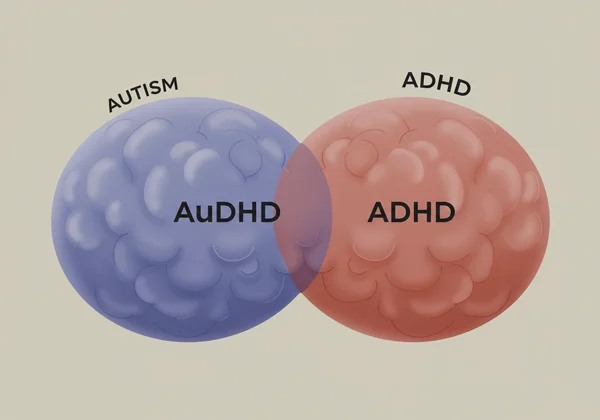
For a long time, clinical guidelines stated that autism and ADHD could not be diagnosed in the same person. We now know this is incorrect; they frequently co-occur. When an individual has both, it's often referred to as AuDHD. This combination creates a unique neurotype with its own set of strengths and challenges, as the traits of both conditions can interact in complex ways.
Shared Challenges: Executive Functioning Difficulties
One of the biggest areas of overlap is in executive functioning. Both autistic individuals and those with ADHD can struggle with organizing tasks, managing time, and initiating activities (a phenomenon known as task paralysis). This shared difficulty can make it hard to distinguish one condition from the other without a thorough evaluation. For example, difficulty completing a school project could stem from ADHD-related distraction or from autistic overwhelm due to unclear instructions.
Misdiagnosis & Masking: The Complexities of Presentation
The significant overlap in traits often leads to misdiagnosis or one condition "masking" the other. For instance, a person might receive an ADHD diagnosis while their underlying autistic traits are overlooked, or vice-versa. This is particularly common in women and girls, who may develop sophisticated coping mechanisms ("masking") to hide their social difficulties or inattentiveness, making their traits less obvious to others. Exploring your experiences with an online autism test can be a helpful starting point.
Key Differences: Distinguishing Between Autism and ADHD
Despite the overlap, there are crucial differences that can help distinguish between autism and ADHD. Understanding these distinctions is key to gaining a clearer picture of your own neurotype. The motivation behind a behavior is often the most revealing factor.
Social Engagement: Quality vs. Quantity in Interactions
While both can involve social challenges, the reasons differ. An autistic person might struggle with the how of social interaction—understanding unspoken rules and interpreting cues—but may deeply value a few close connections. In contrast, a person with ADHD might struggle with the mechanics of conversation due to inattention or impulsivity, such as interrupting others or zoning out, even if they intuitively understand the social rules.
Focus & Interests: Hyperfocus vs. Shifting Attention
Focus is another key differentiator. ADHD is often characterized by an inability to regulate attention, leading to distraction when bored but an intense hyperfocus on topics of high interest. This hyperfocus is often short-lived and can shift rapidly. In autism, the deep focus on special interests is typically more sustained and systematic over long periods. The autistic person seeks to gather deep knowledge, whereas the person with ADHD may be driven more by novelty and immediate stimulation.
Repetitive Behaviors: Purpose & Motivation
Repetitive behaviors look different in each condition. Autistic stimming is often a tool for self-regulation, used to manage sensory overload or express strong emotions. In ADHD, similar behaviors like fidgeting or leg-bouncing are typically a way to release excess energy and improve focus on a boring task. The purpose behind the action is the critical distinction.
Navigating Your Path to a Dual Diagnosis
If you recognize traits of both autism and ADHD in yourself, you might be wondering what to do next. The path to clarity involves self-exploration, professional guidance, and understanding the tools available to you. Remember, this journey is about understanding, not labeling.

Why a Comprehensive Professional Assessment is Crucial
It is essential to emphasize that online screeners are not diagnostic tools. They cannot replace a comprehensive evaluation by a qualified healthcare professional, such as a psychologist or psychiatrist who specializes in adult neurodevelopmental conditions. A formal diagnosis is a thorough process that can provide definitive answers and unlock access to appropriate support and accommodations.
How Online Screeners Can Help Your Self-Discovery Journey
So, where do tools like an autism spectrum test for adults fit in? An online screener is an excellent first step. It can help you organize your thoughts, identify specific traits and experiences to discuss with a doctor, and provide you with the vocabulary to describe what you're feeling. Taking an initial assessment can validate your feelings and give you the confidence to seek a professional opinion.
What to Expect During an AuDHD Assessment Process
A formal assessment for AuDHD typically involves detailed interviews about your developmental history, from childhood to the present day. You may be asked to fill out extensive questionnaires and complete various clinical assessments. The clinician will carefully work to untangle the overlapping symptoms to determine whether you meet the criteria for ASD, ADHD, or both. This process is comprehensive to ensure an accurate picture of your neurotype.
Understanding Your Unique Neurotype: The First Step
Figuring out whether your experiences align with autism, ADHD, or both is a profound journey of self-discovery. The confusion arising from the overlap is real, but so is the clarity that comes from understanding your unique brain wiring. Recognizing your traits is not about finding a label, but about gaining a framework to better understand your strengths, navigate your challenges, and advocate for your needs.
This exploration empowers you to find strategies and communities that resonate with you. If this article has sparked a sense of recognition, we encourage you to take the next step. Visit our homepage to take our free test. It's a confidential, science-based tool designed to provide initial insights and guide you on your path to self-understanding.
Frequently Asked Questions About Autism & ADHD
Can you have both Autism and ADHD (AuDHD)?
Yes, absolutely. It is now widely recognized in the medical community that Autism Spectrum Disorder and ADHD can and frequently do co-occur. This combination, known as AuDHD, creates a unique profile of traits, challenges, and strengths that differ from having either condition alone.
What are the main differences between autism and ADHD symptoms?
The primary differences often lie in the underlying motivation for a behavior. For instance, social difficulties in autism often stem from trouble interpreting social cues, while in ADHD they may arise from impulsivity or inattention. Similarly, intense focus in autism (special interests) tends to be deep and long-lasting, whereas in ADHD (hyperfocus) it can be powerful but more transient.
How do I know if I have AuDHD, and where can I take an initial test?
The only way to know for sure is through a comprehensive assessment by a professional. However, your self-discovery journey can begin right here. If you suspect you have traits of either or both, taking a preliminary online screening can be a valuable first step. You can explore your traits with our free, confidential test.
Is an online autism test accurate for detecting AuDHD traits?
An online autism test is designed as a screening tool, not a diagnostic one. It is highly effective for identifying autistic traits that may warrant further investigation. While it won't diagnose ADHD, the process of answering questions about social, behavioral, and sensory patterns can help you identify overlapping symptoms that you can then discuss with a healthcare provider.
What should I do after taking an online autism spectrum test if I suspect ADHD too?
If your results from an autism spectrum test for child or adult suggest you have autistic traits, and you also strongly relate to ADHD symptoms, the best next step is to seek a professional evaluation. Bring your screening results and a list of your experiences related to both conditions to a clinician specializing in neurodevelopmental disorders for a comprehensive assessment.