Autism vs ADHD vs SPD: Key Differences and When to Consider an Autism Spectrum Test
Have you ever wondered why some people struggle with social cues while others find it impossible to sit still? Perhaps you have noticed your child reacting strongly to loud noises or bright lights. You may be unsure if it is just a phase or something more significant. Navigating the world of neurodevelopmental conditions can feel overwhelming because the signs often overlap.
How can you tell the difference between Autism, ADHD, and SPD? While these three conditions share many similarities, understanding their unique "why" is essential for getting the right support. Many adults and parents find themselves stuck in a loop of searching for answers, only to find conflicting information online.
This guide is designed to clear the fog. We will explore the specific traits of Autism Spectrum Disorder (ASD), Attention Deficit Hyperactivity Disorder (ADHD), and Sensory Processing Disorder (SPD). If you are looking for clarity today, you can start a confidential autism screening to see if your traits or your child’s behaviors align with the autism spectrum.
Understanding the Core Distinctions Between Autism, ADHD, and SPD
To understand the differences, we must first look at what each condition represents at its core. Autism is a developmental condition affecting how a person perceives the world and interacts with others. ADHD is primarily related to executive function. This refers to the brain's ability to manage time, focus, and impulses.
SPD disrupts how the brain processes sensory input. Lights, sounds, textures, or even balance cues can feel overwhelming or distorted. It is common for these conditions to coexist. For example, many people with autism also have ADHD, a combination often called "AuDHD." Similarly, sensory issues are a core part of autism but can also exist as a standalone diagnosis. Understanding these nuances is the first step toward self-discovery or helping a loved one.
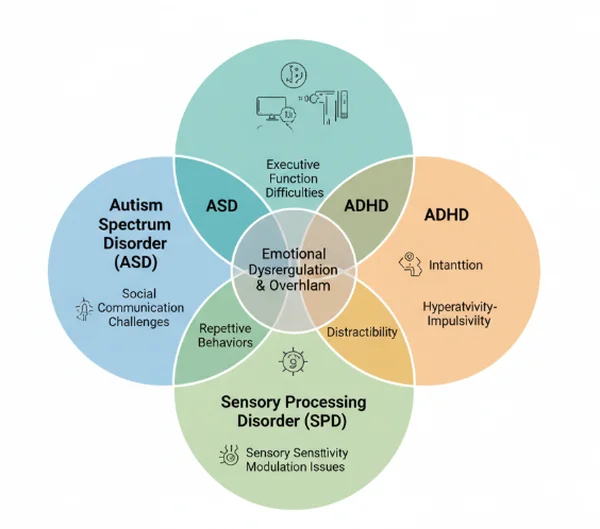
Social Communication in Autism: How ASD Traits Differ from ADHD
Social challenges appear in both autism and ADHD, but the root cause is usually different. Autism often involves difficulty grasping social "unwritten rules." This includes trouble reading body language or sarcasm. Some may also struggle with knowing when to speak in conversations. This is often described as a difference in social intuition.
In contrast, social difficulties in ADHD are often driven by impulsivity or a lack of focus. ADHD may cause impulsive interruptions or missed social cues due to fleeting focus. Thoughts can feel urgent, making it hard to pause during conversations. While an autistic person may not "see" the cue, the person with ADHD might "miss" it due to distraction. Using a tool to review your autism spectrum traits can help you determine if your social patterns are more aligned with the autism spectrum.
Sensory Overload in SPD vs Autism: Online Screening Insights
Sensory Processing Disorder (SPD) occurs when the brain has trouble receiving and responding to information that comes in through the senses. This includes sight, sound, touch, taste, and smell, as well as balance (vestibular) and body position (proprioception). Someone with SPD might feel like a normal light is blinding or that a soft shirt feels like sandpaper.
While sensory sensitivities are a major symptom of autism, SPD can occur without the social or communication challenges found in ASD. In SPD, the sensory system is "misfiring." In autism, sensory issues are often tied to a need for environmental predictability. This can lead to "stimming" (repetitive behaviors) to self-regulate. Identifying these patterns is a key part of an online autism screening.
Symptom Comparison Guide: Side-by-Side Analysis
When we look at these conditions side-by-side, we can see where the lines blur and where they remain distinct. Many parents notice that their children have high energy (ADHD) but also have very specific interests (Autism). By breaking down these behaviors into categories, we can better understand the unique profile of the individual.
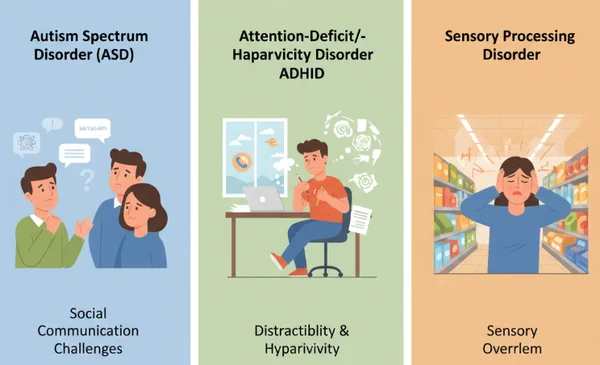
Social Interaction Patterns Across the Conditions
- Autism: Preference for solitary play or specific "parallel" play. Difficulty with eye contact and understanding the emotional states of others. Conversations may focus heavily on a single "special interest."
- ADHD: Highly social but may struggle with social boundaries. May talk excessively or jump between topics rapidly. Boredom in social settings can lead to "zoning out" or seeking more stimulating environments.
- SPD: Social interactions may be avoided specifically to escape overwhelming sensory environments. This includes loud parties or crowded malls. The avoidance is not due to a lack of social understanding, but a physical need for "sensory safety."
If you recognize these social patterns in yourself, you might consider how to complete a preliminary autism evaluation to gather more information.
Attention and Executive Function: ADHD's Signature Features
Executive function acts as the "CEO" of the brain. It handles planning, organization, and emotional control. While autistic individuals often struggle with transitions and changes in routine, those with ADHD struggle with the mechanics of starting and finishing tasks.
In ADHD, the "attention" issue is often a problem of regulation. A person might "hyper-focus" on something they love for hours but find it impossible to focus on a simple chore for five minutes. In autism, focus is often directed toward specific systems, facts, or collections. While both involve deep focus, the ADHD focus is often more erratic. The autistic focus is usually more systematic and repetitive.
Sensory Sensitivities and Responses in Each Condition
Sensory responses vary significantly across the neurodivergent spectrum. An autistic individual might use sensory input to calm down, such as rocking or hand-flapping. This is known as stimming. Someone with ADHD might seek out sensory input—like fidgeting or leg shaking—to help their brain stay "awake" and focused.
For those with SPD, the reaction is often a direct "fight or flight" response. A loud noise might cause a physical panic attack or an immediate need to leave the room. Understanding if your sensory needs are tied to focus, emotional regulation, or pure physical processing is vital. You can start exploring these traits through our access a digital autism screening tool.
When to Consider Targeted Screening: Identifying Key ASD Traits and Indicators
Knowing when to seek a formal evaluation is a common concern for many families and self-exploring adults. Screening is not a diagnosis, but it provides a "road map" for what to do next. It helps you decide whether you should talk to a pediatrician, a psychiatrist, or an occupational therapist.
Autism Screening: Key Indicators to Look For
If you are noticing a combination of social difficulties and repetitive behaviors, an autism screening is a logical first step. Key indicators include:
- Difficulty maintaining "back-and-forth" conversation.
- Strong preference for routines and distress when they change.
- Highly restricted interests that are intense in focus.
- Sensory sensitivities combined with social withdrawal.
For many, using a tool to start an initial autism assessment provides the initial evidence needed to advocate for a professional assessment.
ADHD Assessment: Identifying Core Executive Function Challenges
ADHD is often suspected when a person’s daily life is significantly disrupted by disorganization or impulsivity. Warning signs include:
- Frequently losing items like keys, phones, or schoolwork.
- Difficulty following multi-step instructions.
- A constant feeling of restlessness or feeling "driven by a motor."
- Impulsive decision-making without considering consequences.
While ADHD and autism are different, they often overlap. If you have been diagnosed with ADHD but still feel there are parts of your experience—like social confusion—that aren't explained, an autism screening may be helpful.
SPD Indicators: When Sensory Needs Become Overwhelming
SPD is often identified when sensory "meltdowns" occur frequently. A meltdown is different from a tantrum; it is a neurological "overload" where the person can no longer process their environment. Signs of SPD include:
- Extreme distress over clothing textures (like socks or tags).
- Being a very "picky eater" based on food texture rather than taste.
- Fear of unexpected touches or being in crowds.
- Being "clumsy" or frequently bumping into things (poor body awareness).
Next Steps: Moving Toward Clarity and Support
Identifying whether your challenges stem from social intuition (Autism), executive function (ADHD), or sensory processing (SPD) allows you to find strategies that actually work. Clarity helps you find tailored strategies—whether it’s sensory accommodations for SPD or executive function tools for ADHD.
If sensory overload or social confusion impacts your daily life, our science-based autism spectrum test can help you pinpoint patterns. Share your results with a professional to explore customized support. If you are ready to gain more insight into your traits, we invite you to identify your neurodivergent profile today. Our tool provides a science-based summary and offers an optional AI-driven report to help you plan your next steps with confidence.
The Takeaway
Can someone have both autism and ADHD?
Yes, this is very common and is often referred to as "AuDHD." Research suggests that a significant percentage of people on the autism spectrum also meet the criteria for ADHD. Having both means a person might experience the social and routine-oriented traits of autism alongside the impulsivity and focus challenges of ADHD. If you suspect you have both, you can assess adult autism traits to help clarify one side of that equation.
How can I tell if my child's sensory issues are part of autism or SPD?
The main difference lies in the presence of social and communication challenges. If your child has sensory sensitivities but communicates typically and understands social cues, it may be SPD. However, if these sensory issues are paired with a preference for being alone, repetitive movements, or delayed speech, it is more likely to be part of the autism spectrum.
Are online autism tests accurate for distinguishing between these conditions?
Online tests are screening tools, not diagnostic tools. They are designed to identify traits associated with the autism spectrum based on established research. While they cannot provide a medical diagnosis for ADHD or SPD, they are excellent for helping you decide if your symptoms warrant a professional autism evaluation. You can view your screening results instantly to help guide your conversation with a doctor.
What should I do if the test indicates high autism traits?
A "positive" screening result is the beginning of a conversation. The best next step is to take your results to a healthcare professional, such as a GP, psychologist, or psychiatrist. You can use the summary from our online screening tool to explain your concerns clearly and advocate for a formal assessment.