Autistic Definition: What It Means to Be Autistic
An autistic definition should do more than translate a word. It should explain that being autistic usually means a person has lifelong differences in how they communicate, process sensory information, relate to social expectations, use routines, and focus attention. Autism is often discussed medically as autism spectrum disorder, or ASD, but many autistic people also describe it through identity, neurodiversity, strengths, barriers, and support needs. If you are trying to understand the word for yourself, your child, or someone you support, the autism spectrum self-reflection tool can be a gentle place to organize observations while remembering that online screening is not the same as a formal professional evaluation.
Autistic Simple Definition
Autistic means relating to autism, a lifelong neurodevelopmental difference that can affect how a person experiences the world, communicates, learns, notices patterns, responds to sensory input, and manages change. A simple definition is: an autistic person has a brain and nervous system that work in autistic ways.
That sounds broad because autism is broad. The word "spectrum" does not mean a line from mild to severe. It means autistic people can have very different combinations of traits, strengths, challenges, communication styles, and support needs. One person may speak fluently but feel exhausted by social decoding. Another may use few spoken words but communicate clearly through writing, gestures, devices, or behavior. Another may seem very independent in one setting and need substantial help in another.
It is also important to separate a definition from a stereotype. Being autistic does not mean a person lacks empathy, has one fixed personality type, or fits a single public image. Autism can be visible or less visible. It can be recognized in childhood, noticed later in adulthood, or missed for years when a person has learned to mask discomfort.
Autistic, Autism, ASD, and Autist: How the Words Differ
The word "autistic" is usually an adjective: an autistic adult, an autistic child, autistic traits, autistic communication. Many people also use it as an identity word: "I am autistic." This identity-first language is preferred by many autistic self-advocates because autism is not experienced as a detachable add-on. Some people prefer person-first language, such as "person with autism." Respect the language a person uses for themself.
"Autism" is the broader noun. "Autism spectrum disorder" is the medical term often shortened to ASD. In everyday educational writing, "autism" and "ASD" may point to the same overall condition, but they can feel different. "ASD" sounds clinical. "Autism" can be used in medical, educational, family, and identity contexts.
"Autist" appears in some searches, including "autist definition" and "definition of autist." In English, it is less commonly used in everyday respectful conversation than "autistic person" or "autistic people." Terms such as "autista" or "autisten" may come from other languages or multilingual searches. If you are writing in English, "autistic person" is usually clearer and more natural.
What Defines a Person as Autistic?
In formal clinical frameworks, autism is generally recognized through patterns in two broad areas: social communication and interaction, and restricted or repetitive patterns of behavior, interests, routines, or sensory responses. Those categories are useful, but they can sound cold if they are not translated into everyday life.
Social communication differences may include using eye contact differently, finding indirect social rules confusing, preferring direct language, needing extra time to process conversation, or communicating more comfortably in writing than speech. These differences do not mean an autistic person does not care about others. They may simply read and express social information differently.
Routine, repetition, and focused interests can also be part of autistic experience. A person may feel steadier with predictable plans, become deeply absorbed in specific topics, repeat movements or phrases, or rely on familiar patterns to manage energy. These traits are not automatically negative. Focused interests can support learning, joy, expertise, and connection.
Sensory processing is another major part of many autistic lives. Sounds, lights, textures, smells, tastes, movement, temperature, or internal body signals may feel unusually intense, muted, or hard to filter. A busy room that seems normal to one person may feel overwhelming to another. A quiet, predictable environment can make communication and daily tasks much easier.
Because traits vary so much, no single behavior defines every autistic person. The better question is whether a lifelong pattern of autistic traits affects daily life, relationships, learning, work, comfort, or support needs. If you are collecting observations, an AQ-style autism screening starting point may help you reflect on patterns before deciding whether to seek more guidance.
Five Common Autistic Traits, Explained Carefully
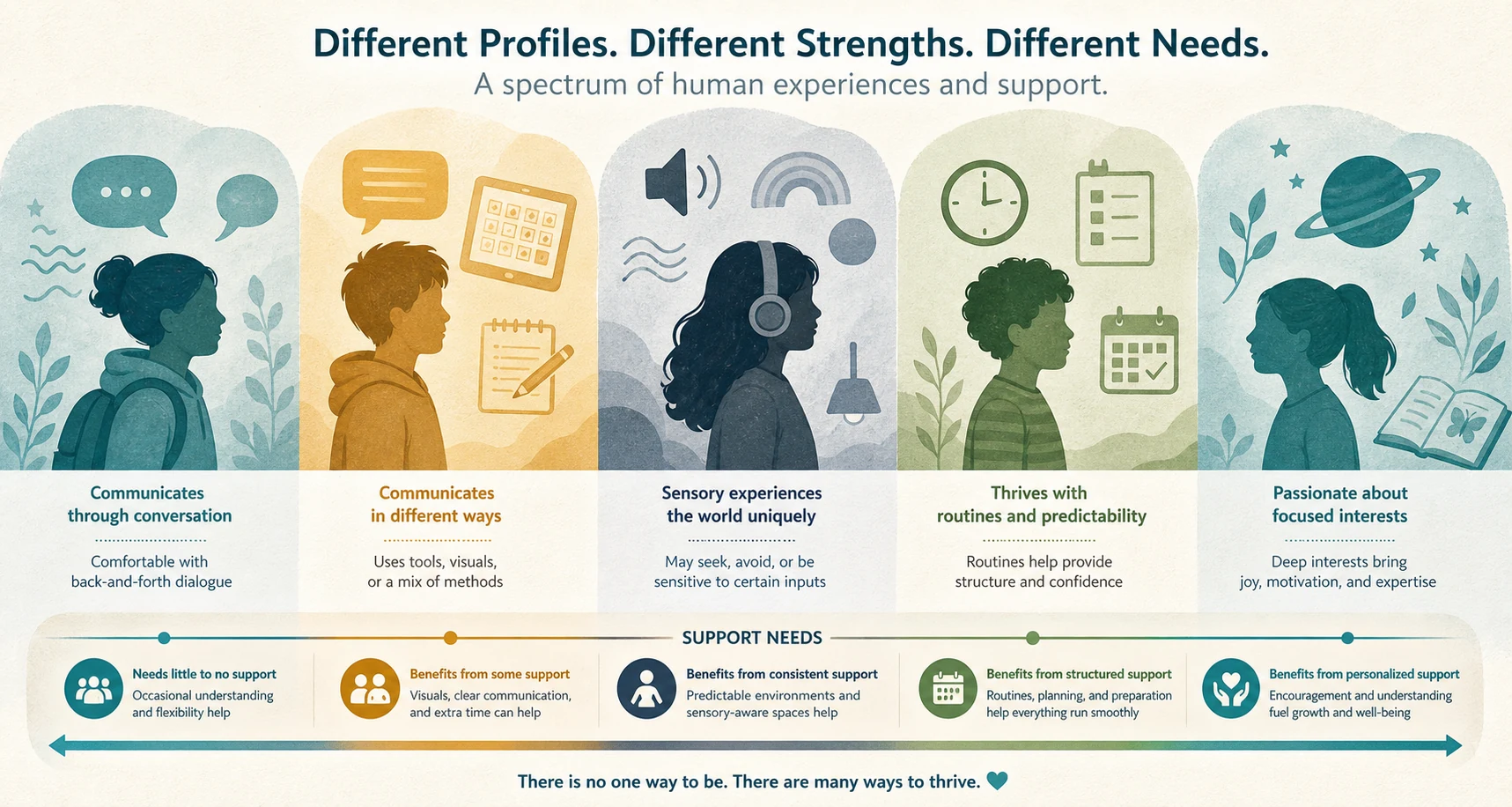
Searchers often ask for "5 symptoms of autism." A more respectful phrase is "common autistic traits," because many traits are differences rather than problems. Still, these five areas can help people understand the definition.
First, communication may differ. Some autistic people speak often, some speak sometimes, and some use other communication methods. Tone, facial expression, small talk, implied meaning, or fast group conversation may require extra effort.
Second, social interaction may differ. An autistic person may prefer fewer relationships, more structured interaction, shared activities instead of open-ended chatting, or clearer expectations. This is not the same as being uncaring or antisocial.
Third, sensory processing may differ. A person may be sensitive to sound, light, clothing tags, food textures, crowded spaces, or sudden touch. Others may seek strong sensory input through movement, pressure, sound, or visual patterns.
Fourth, routines and transitions may matter. Unexpected changes can require more energy because the person has already built a mental plan for what comes next. Preparation, warnings, written steps, and predictable rhythms can reduce stress.
Fifth, interests and attention may be unusually focused. Deep interest can look like long research sessions, detailed memory, repeated conversation about a topic, or strong motivation around a narrow subject. In the right context, this can be a strength.
These traits can appear alongside strengths such as honesty, pattern recognition, persistence, creativity, precise memory, loyalty, or deep expertise. They can also appear alongside exhaustion, anxiety, shutdowns, meltdowns, burnout, or practical support needs.
What Autistic Does Not Mean
Autistic does not mean broken, emotionless, childish, rude, or unable to live a meaningful life. It does not mean every challenge comes from autism alone. Sleep, anxiety, ADHD, trauma, physical health, school demands, workplace pressure, and family expectations can all shape daily experience.
Autistic also does not mean "a little quirky" in a casual way. Everyone has preferences, habits, and sensitivities. Autism refers to a broader lifelong pattern that can affect multiple parts of life.
The word should not be used as an insult or to mock someone for being literal, quiet, direct, socially different, or deeply interested in something.
Autistic Definition for Kids and Families
For kids, the simplest explanation is often the most useful: autistic brains notice, feel, learn, and communicate in their own ways. An autistic child may need extra help with changes, noise, friendship rules, speech, daily routines, or sensory comfort. They may also have strong interests, honest reactions, creative thinking, and meaningful ways of showing connection.
Parents and caregivers can watch for patterns without turning every behavior into a warning sign. For example, a child who covers their ears may be overwhelmed by sound. A child who repeats lines from a show may be communicating through familiar language. A child who lines up toys may be creating order or exploring patterns. Context matters.
For families, a helpful next step is to write down examples: what happened, what seemed difficult, what helped, and whether the pattern appears across settings.
Adult Autistic Definition: Why It Can Be Missed
Adults often search for "definition of being autistic" after years of feeling different without having clear language for it. Some adults did not fit childhood stereotypes. Some were quiet, high-achieving, or heavily masked. Some were labeled anxious, sensitive, gifted, difficult, or socially awkward without anyone asking whether autism might explain the pattern.
Adult autistic traits may show up as social fatigue after work, intense preparation before conversations, difficulty switching tasks, sensory overload, strong routines, deep interests, or a feeling of performing social normality. Together, across a lifetime, they may be worth exploring.
For adults, the goal is not to rewrite a whole life into one label. The goal is to understand patterns that may affect energy, relationships, work, self-care, and self-compassion. Some people pursue formal assessment. Others start with education, accommodations, community stories, or private reflection.
How to Know If the Word May Fit Your Experience
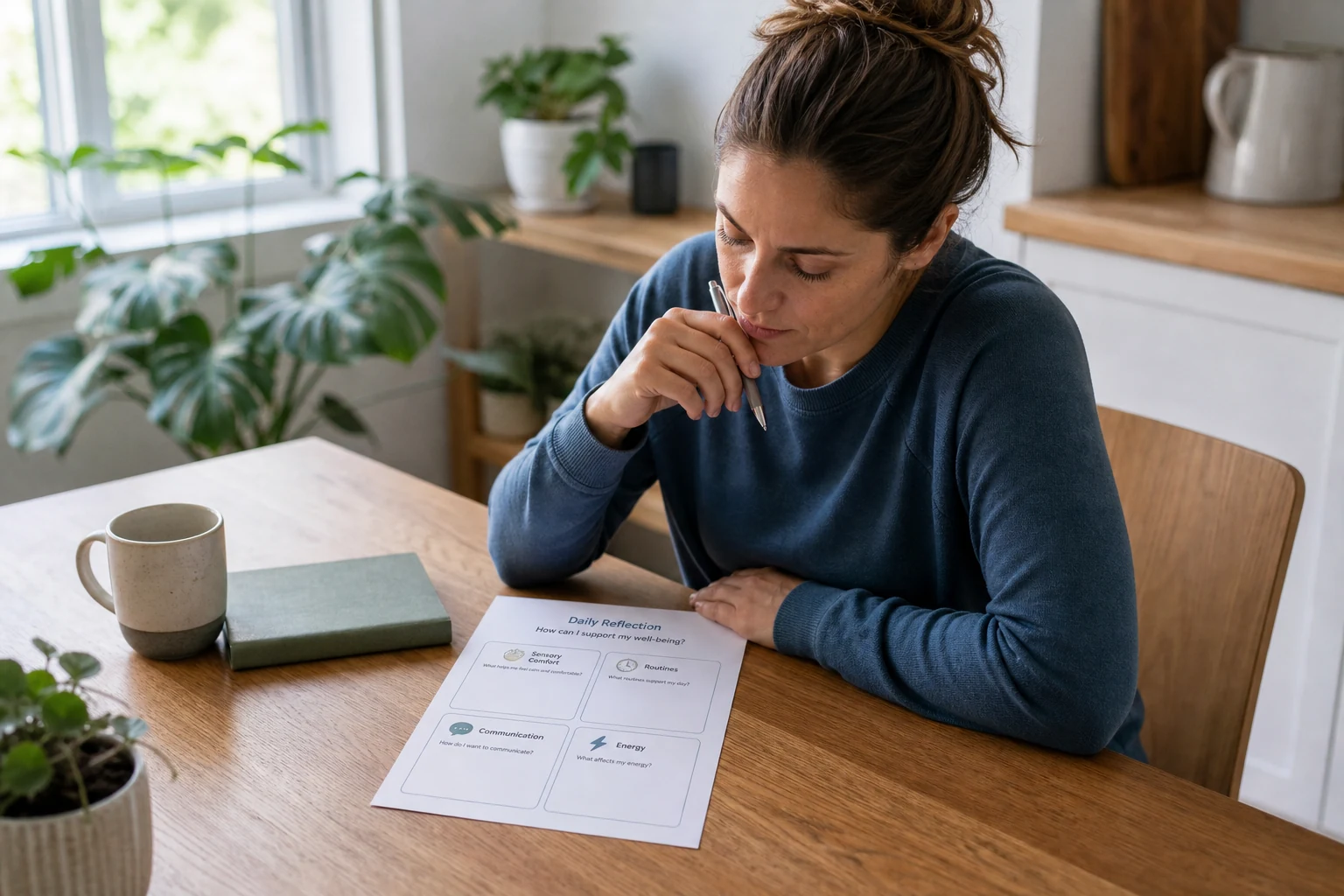
If you are wondering whether "autistic" may describe you, begin with patterns rather than isolated moments. Ask yourself:
- Have these traits been present for a long time, often since childhood?
- Do they show up in more than one setting, such as home, work, school, relationships, or public spaces?
- Do sensory environments, transitions, communication demands, or uncertainty affect your energy more than other people seem to expect?
- Do routines, focused interests, direct communication, or quiet recovery time help you function better?
- Have you spent years masking discomfort or copying social behavior to get by?
These questions cannot give a final answer, but they can help you organize your thinking. If your experiences affect safety, mental health, school, work, parenting, or daily living, consider speaking with a qualified professional who understands autism across ages, genders, cultures, and communication styles.
A Gentle Next Step After Learning the Autistic Definition
Once you understand the autistic definition, the next useful move is usually practical: notice patterns, reduce shame, and choose one small support experiment. That might mean using headphones in loud places, asking for written instructions, planning transition time, simplifying social commitments, or tracking energy after demanding events.
If you want a structured reflection point, you can review an educational autism spectrum test and treat the result as information to think with, not a final label. Bring notes to a professional conversation if you want deeper guidance. Share language preferences with people you trust. Most of all, remember that the purpose of a definition is not to put a person in a box. It is to make real needs, strengths, and experiences easier to understand.
FAQ
What is the exact meaning of autistic?
Autistic means relating to autism. When used for a person, it means the person has autistic neurodevelopmental traits that can affect communication, sensory processing, routines, focused interests, social interaction, and support needs.
What defines a person as autistic?
A person is usually understood as autistic when they have a lifelong pattern of autistic traits across social communication and interaction, along with routines, repetitive patterns, focused interests, or sensory differences. A formal assessment considers development, daily impact, and context.
Is autistic the same as autism spectrum disorder?
They are closely related. "Autistic" is commonly used as an identity or descriptive word. "Autism spectrum disorder" or "ASD" is the clinical term used in formal evaluation and records. Many people use "autism" in everyday educational contexts.
What are five common autistic traits?
Five common areas are communication differences, social interaction differences, sensory processing differences, reliance on routine or predictability, and focused or repetitive interests and behaviors. The exact mix varies from person to person.
How do I know if I am autistic?
Look for long-term patterns across your life, not one trait in isolation. Reflect on sensory needs, communication style, social energy, routines, attention patterns, childhood history, and daily support needs. If the question matters for your wellbeing or access to support, consider a qualified professional evaluation.
What is the Chinese meaning of autistic?
In Chinese, "autistic" is often translated as "自闭症的" when used as an adjective, or "自闭症人士 / 自闭症者" when referring to a person. In respectful English writing, "autistic person" is often clearer than older or awkward labels.
Is autism an illness?
Autism is generally understood as a neurodevelopmental difference or neurodivergence, not a temporary illness. Autistic people may need support, accommodations, healthcare, education services, or community understanding, depending on their individual needs.