Cause of Autism and What Research Says About Risk Factors
Searching for the cause of autism can feel strangely urgent, especially if you are trying to understand your child, your own lifelong patterns, or a recent question raised by a teacher or clinician. The most accurate short answer is also the least dramatic: autism spectrum disorder does not have one single known cause. Research points to a mix of genetic, biological, prenatal, and environmental risk factors that can influence early brain development in different ways. This guide explains what is known, what is still uncertain, and how to think about cause without blame. If you are exploring traits alongside the science, a gentle autism spectrum screening resource can be a calm first step, not a final answer.
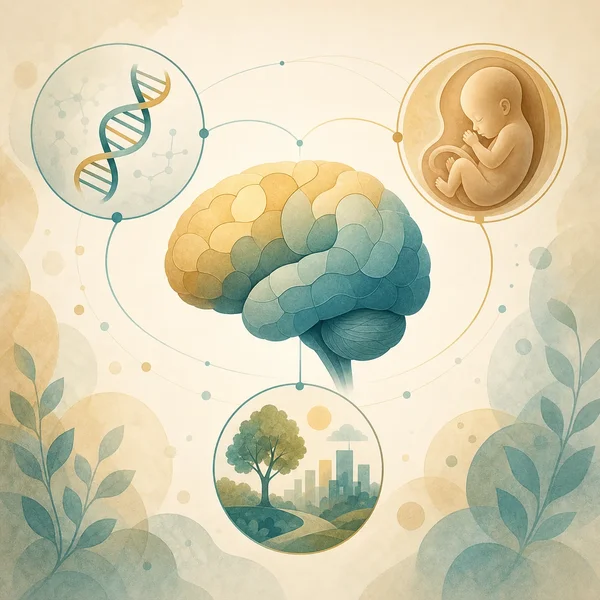
The Short Answer on the Cause of Autism
Autism is a neurodevelopmental difference, which means the relevant changes begin during early brain development. For most people, there is no single event, exposure, parenting choice, food, or personality trait that explains why autism is present. Instead, researchers describe autism as multifactorial: many factors can combine, and the same outward traits may arise through different developmental pathways.
That matters because "cause" can mean several things. A genetic condition may be a known contributing factor for one person. A pregnancy or birth complication may be part of another person's risk picture. For many people, no single source is ever identified. A risk factor also is not the same as a direct cause. A factor may raise the likelihood of autism across a population, while most people exposed to that factor will not be autistic, and many autistic people will not have that factor in their history.
The most useful way to read cause-of-autism research is to ask: What broad categories are supported? How strong is the evidence? Does this apply to one person's situation, or only to group-level risk? That approach keeps the topic practical without turning it into certainty where certainty does not exist.
What Are the Three Main Causes of Autism
People often ask for the "three main causes of autism," but the better phrase is "three main categories of influence." Those categories are genetics, prenatal and early-life biological factors, and environmental influences that may interact with biology.
Genetic influences
Genetics is the strongest broad category in autism research. Autism tends to run in families, and many studies suggest that inherited genetic differences account for a large share of autism likelihood. In some people, autism is associated with a known genetic condition, such as fragile X syndrome, Rett syndrome, or a chromosome difference. In many others, there is no single named syndrome; instead, many common genetic variations may each add a small amount of risk.
This is why the phrase "genetic cause of autism" needs care. For a minority of people, a specific genetic finding may help explain their developmental profile. For many, genetics means a pattern of inherited or new gene changes that influence how the brain develops, not a simple one-gene answer.
Prenatal and early developmental biology
Autism-related brain development begins before birth and continues through early childhood. Factors discussed in research include parental age, prematurity, very low birth weight, some pregnancy complications, maternal immune or metabolic conditions, and periods of oxygen deprivation around birth. These factors do not "make autism happen" in a simple linear way, but they may influence developmental risk in some children.
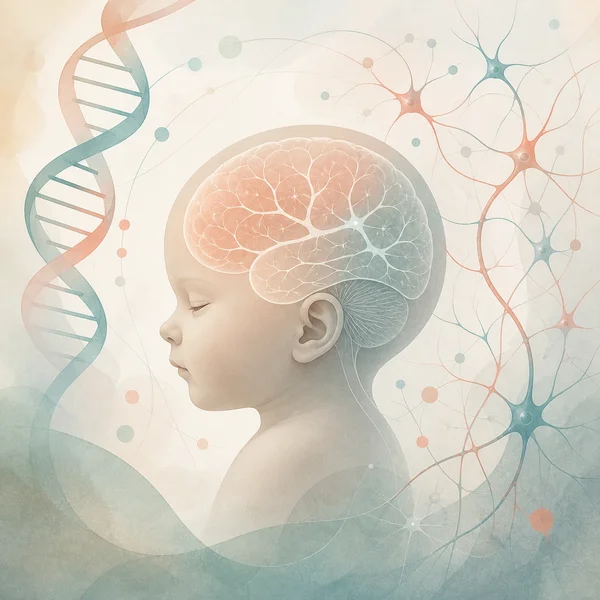
This category also helps answer a common question: what causes autism in the brain? Research suggests that autism can involve differences in how brain cells communicate, how networks develop, and how sensory, social, language, and flexibility systems are organized. Those differences are not defects in character or effort. They are developmental patterns that can affect daily life in both challenging and strength-based ways.
Environmental influences
In autism research, "environmental" does not simply mean chemicals or pollution. It can mean any non-genetic influence, including prenatal health, birth factors, nutrition, infection, air pollution, medication exposure, and social determinants that shape access to care. Some environmental factors have stronger evidence than others, and many findings are associations rather than proof of direct cause.
For readers comparing traits with everyday experience, an AQ-style autism spectrum test can help organize observations before a professional conversation. It should be used as screening and self-reflection, not as a clinical conclusion.
What Causes Autism During Pregnancy
Many searches around autism causes focus on pregnancy because early brain development is especially active before birth. Research has explored maternal infection, fever, immune conditions, diabetes, obesity, exposure to air pollution, certain pesticides, some medications, and severe prematurity. These findings should be read as risk signals, not as personal blame.
For example, a study may find that a particular prenatal exposure is associated with a higher rate of autism across a large group. That does not mean the exposure is the sole cause for any individual child. It also does not mean a parent could have known every risk or controlled every variable. Pregnancy involves complex biology, unequal access to care, and many factors that are outside a person's control.
Acetaminophen, often known by the brand name Tylenol, is one of the more sensitive recent topics. Some observational studies have reported associations between frequent or prolonged prenatal acetaminophen exposure and later neurodevelopmental outcomes. Association is not the same as causation. Fever and pain during pregnancy can themselves matter, and the reasons a person uses medication may be part of the research picture. Anyone who is pregnant or planning pregnancy should discuss medication choices with a qualified clinician instead of using internet articles as medical instructions.

Environmental Causes of Autism and What That Phrase Really Means
The phrase "environmental causes of autism" can be misleading if it sounds like researchers have found one outside exposure that explains autism. They have not. The better way to frame it is environmental risk factors.
Air pollution is one researched example. Some studies have found links between prenatal or early-life exposure to traffic-related air pollution and higher autism likelihood. Other research has explored pesticide exposure, heavy metals, maternal nutrition, infection, inflammation, and birth complications. These topics are important because they may point to preventable risks or better pregnancy and early-childhood support, but they do not erase the strong role of genetics.
Environmental research is also difficult. People are exposed to many things at once, exposures are hard to measure perfectly, and families differ in genetics, health care access, stress, nutrition, neighborhood conditions, and screening opportunities. A careful article should not turn every association into a headline that says "scientists found the cause of autism." Good science usually moves more slowly than that.

What Is the Strongest Cause of Autism
If you are asking about the strongest broad influence, genetics is usually the best answer. Family and twin studies consistently show a strong inherited component. Some estimates place genetic contribution very high, though the exact number varies by study design and population.
Still, "strongest" does not mean "only." Autism is not one biological pathway. Two autistic people may share communication differences, sensory sensitivities, or a preference for routine, yet have different underlying genetic and developmental histories. This is one reason the word spectrum matters. It describes a wide range of support needs, traits, strengths, and life experiences.
The question "what is 90% of autism caused by?" usually comes from simplified summaries of heritability research. Heritability is not the percentage of a person's autism that comes from genes. It is a population-level estimate of how much variation in autism likelihood can be statistically linked to genetic differences in a particular study context. That distinction is subtle, but it prevents a lot of confusion.
What Does Not Explain Autism by Itself
Several older ideas about autism have been rejected or heavily revised. Autism is not caused by cold parenting, weak discipline, screen habits alone, or a child being stubborn. Those explanations are stigmatizing and unsupported.
Vaccines are another common concern. Large scientific reviews across many years have not found a causal link between vaccines and autism. Autism traits are often noticed around the same years that children receive routine childhood vaccines, which can make timing feel suspicious. Timing alone is not proof of cause. Families with vaccine questions should speak with a pediatric professional who can discuss both vaccine safety and the risks of vaccine-preventable illness.
It is also inaccurate to say autism is caused by one food, one supplement shortage, one parenting style, one school environment, or one emotional event. Supportive environments can change quality of life, communication access, stress levels, and skill development. They do not rewrite the basic neurodevelopmental origin of autism.
Cause, Symptoms, and Age Noticed Are Different Questions
Cause-of-autism searches often mix together three different questions: why autism occurs, what autism looks like, and when someone notices it. Keeping them separate makes the topic easier.
Autism symptoms, or traits, usually involve differences in social communication, sensory processing, repetitive movements or speech, intense interests, preference for sameness, or difficulty with transitions. Some children show clear signs in the first two years of life. Others are recognized later, especially if their traits are subtle, masked, or misunderstood as shyness, anxiety, giftedness, defiance, or social awkwardness.
In adults, the cause did not begin in adulthood; rather, the person may only recently have found language for lifelong patterns. In children, a parent may first notice speech differences, limited response to name, unusual play, strong sensory reactions, or distress around routine changes. Either way, cause research should not replace a careful look at lived experience, developmental history, support needs, and context.
How to Use Cause of Autism Research Without Self-Blame
The healthiest use of cause-of-autism research is not to assign fault. It is to understand that autism is complex, biologically rooted, and shaped by many interacting factors. For parents, that can soften the fear that one ordinary decision explains everything. For adults, it can offer a framework for self-understanding without reducing identity to a lab finding or risk statistic.
If autism traits are part of your question, the next step can be gentle and practical: write down examples, note sensory and communication patterns, ask trusted people what they have observed, and consider whether a formal evaluation would be useful. A self-reflection autism screening resource can help organize that first layer of information before deciding what support, reading, or professional guidance makes sense.
Research will keep changing, especially around gene-environment interaction and early brain development. What should stay steady is the tone: curious, careful, and respectful of autistic people as whole people, not as puzzles to solve.

FAQ
What are the three main causes of autism?
There are not three simple causes. The clearest categories are genetic influences, prenatal and early developmental biological factors, and environmental risk factors that may interact with biology. None of these categories explains every autistic person.
What is 90% of autism caused by?
Some studies report high heritability estimates, sometimes in the range people summarize as close to 90%. That does not mean one person's autism is 90% caused by genes. It means genetic differences explain a large share of population-level variation in autism likelihood in certain studies.
What causes autism during pregnancy?
No single pregnancy factor explains autism. Research has explored infection, immune and metabolic conditions, prematurity, very low birth weight, air pollution, some medication exposures, and birth complications. These are risk factors or associations, not automatic causes.
What is the strongest cause of autism?
Genetics is the strongest broad influence supported by research, but autism is usually multifactorial. Genes, early brain development, prenatal biology, and environmental risk factors may combine differently from person to person.
At what age is autism usually noticed?
Autism traits are often noticed in early childhood, sometimes in the first two years. Some people are recognized later because traits can be subtle, masked, or mistaken for other differences. Adults may only recently connect lifelong patterns with autism.
Can lack of oxygen at birth cause autism?
Birth complications involving oxygen deprivation have been studied as a possible risk factor. They do not explain most autism, and they do not mean every child with such a complication will be autistic. A clinician can help interpret an individual birth history.
Is Tylenol a cause of autism?
Current evidence does not prove that acetaminophen or Tylenol is a direct cause of autism. Some studies report associations, while other research raises questions about confounding factors. Medication decisions during pregnancy should be made with a qualified clinician.